


New special issue call for papers on "Politics, Culture and Society" - Submit by October 31, 2026

New special issue call for papers on "Politics, Culture and Society" - Submit by October 31, 2026

New special issue call for papers on "Politics, Culture and Society" - Submit by October 31, 2026

New special issue call for papers on "Politics, Culture and Society" - Submit by October 31, 2026

January - June 2026

Volume 1, Issue 1 - $2026Current Issue

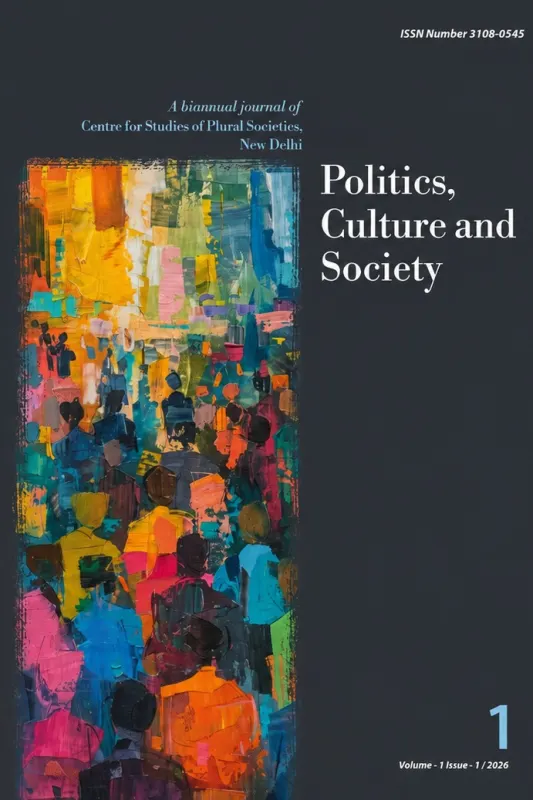
Volume 1 Issue 1 Cover
Full Issue Access Required

This issue is closed access. Purchase or subscribe to download or preview the full issue.

Issue Price: INR 500.00

Issue Details:

Volume 1 Issue 1
Published:Aug 31, 2026

Editorial: January - June 2026

Welcome to the 2026 issue of Politics, Culture and Society. This issue showcases the remarkable breadth and depth of contemporary research across multiple disciplines. From cutting-edge applications of machine learning in climate science to the revolutionary potential of quantum computing in drug discovery, our featured articles demonstrate the power of interdisciplinary collaboration in addressing global challenges.

We are particularly excited to present research that bridges traditional academic boundaries, reflecting our journal's commitment to fostering innovation through cross-disciplinary dialogue. The integration of artificial intelligence with environmental science, the application of blockchain technology to supply chain management, and the convergence of urban planning with smart city technologies exemplify the transformative potential of collaborative research.

As we continue to navigate an era of rapid technological advancement and global challenges, the research presented in this issue offers both insights and solutions that will shape our future. We thank our authors, reviewers, and editorial board members for their continued dedication to advancing knowledge and promoting scientific excellence.

Dr. Omair Anas
Editor in Chief
Politics, Culture and Society

Articles in This Issue

Showing 11 of 11 articles

Research Paper

Research PaperID: PCS110004Pages 1-5Open AccessOpen Access

Editorial’s Introduction Imagining Public Plural Spaces

Azeema Saleem

This issue of the Journal of Politics, Culture and Society, titled Imagining Plural Public Spheres, examines pluralism as an ongoing political, institutional, and democratic practice rather than merely a demographic condition of coexistence. It explores how public spaces are continuously constructed, negotiated, and contested amid unequal power relations, technological transformation, political fragmentation, and social change. Drawing on legal, cultural, political, economic, and historical perspectives, the contributions investigate diverse dimensions of plural public life, including legal pluralism, digital markets, community identities, caste, religious pluralism, new media, print culture, gender, and the normalization of violence. The issue highlights how institutions, technologies, markets, narratives, and social practices can both facilitate participation and reproduce exclusion, hierarchy, and domination. By bringing together empirical, theoretical, and historical approaches, the contributions question conventional distinctions between public and private spheres and examine the processes through which individuals and communities gain visibility, recognition, and political significance. The issue ultimately conceptualizes the plural public sphere as a dynamic and contested domain that requires continuous democratic negotiation of difference, belonging, participation, and power.

PluralismPublic SphereDemocratic ParticipationLegal PluralismSocial DiversityPolitical Fragmentation+14 more
85 views
45 downloads

Contributors:

 Azeema Saleem
Research PaperID: PCS110005Pages 1-20Closed AccessClosed Access

Beyond the Majoritarian Horizon: Examining the Indian Narrative of Minority Rights and Liberal Public Sphere

Sumit Howladar

The paper examines the structure of the public sphere in India with a special focus on the minority rights discourse. To help reimagine this concept, it draws upon the theoretical interventions made by Jürgen Habermas, namely communicative action, Will Kymlicka’s liberal defense of group-differentiated rights, Iris Marion Young’s transformative politics of difference and Bhikhu Parekh’s dialogical model of multiculturalism. It maps the complex constitutional landscape around minority rights and the deep-seated tensions among the stakeholders responsible for a pluralistic public sphere, seeking to understand the anatomy of minority rights in India and its connection with building a liberal public sphere. Four areas- normative, institutional, pedagogical, and technological- demand a reset to make the public sphere more receptive. On the normative side, a dominant didactic framework directly bears on the public sphere; institutionally, the paper highlights the need for accommodative templates to facilitate the minority communities’ engagement with the state. Pedagogical intervention is critical, since the lack of a critical discourse reproduces social exclusion and defeats a genuine public sphere. The paper also discusses the unprecedented digital expansion in India and the degree of its alignment with the effort of creating a liberal public sphere.

MinorityRightsPublicSphereDigitalConstitutional+1 more
109 views
0 downloads

Contributors:

 Sumit Howladar
ORCID
Research PaperID: PCS110006Pages 21-46Closed AccessClosed Access

Shadows of Peace: Hegemony, Violence, and the Unfinished Plural Public Sphere in Post-War Sri Lanka: A Critical Analysis of Easter Sunday Attacks in Sri Lanka

Sachini Geethanjalee, Nethmi Sakalasooriya

Sri Lankan Post-war public sphere was constructed with the aspiration of plural coexistence. Nevertheless, within a decade of the civil war’s end in 2009, coordinated suicide bombings on Easter Sunday in 2019 targeting Catholic churches and luxury hotels shattered that aspiration and exposed structural failures beneath it. This study investigates why ethno-religious intra-state conflict persists in post-war Sri Lanka despite sustained peacebuilding efforts, taking the Easter Sunday attacks as its analytical fulcrum. Using qualitative fieldwork at Katuwapitiya in Western Province, including in-depth interviews, discussions, observations, newspapers and academic articles, this study argues that the attacks cannot be understood outside the longer history of Sinhala-Buddhist hegemony structuring Sri Lankan statecraft since independence. Based on Gramsci’s hegemony, Ted Gurr’s relative deprivation theory and Gellner’s nationalism framework, the research demonstrates that the Easter Sunday bombings functioned simultaneously as a social declaration, a political instrument and an expression of unresolved ethno-religious tensions that post-war administrations failed to address. The findings highlight that political actors instrumentalized the attacks to consolidate majoritarian power, that extremist social movements depended on communal divisions, and that justice for victims remains systematically deferred. The research also reveals that although relations between Catholic and Muslim communities were seriously challenged by the attacks, grassroots solidarity and cooperation between neighbors remained resilient. This demonstrates a form of everyday pluralism that challenges narratives of permanent communal conflict often promoted by political actors.

Easter Sunday AttackEthno-Religious ConflictMinority RightsPost-War Sri LankaReconciliationSinhala-Buddhist Hegemony
96 views
0 downloads

Contributors:

 Sachini Geethanjalee
ORCID
,
 Nethmi Sakalasooriya
Research PaperID: PCS110007Pages 47-70Closed AccessClosed Access

Plural Market Publics: Digital Platforms and Women’s Economic Participation in Jaipur’s Handicraft Sector

Divya Mehta

In India’s handicraft sector, women have long been central to production yet excluded from visible market spaces and denied public authority within them. This paper asks what happens when selling moves online in the context of gendered spheres of craft production and entrepreneurship. Drawing on interviews with ten women entrepreneurs in Jaipur and observation of bazaars and digital selling practices, it examines how digital platforms enable middle-class women to enter new markets, build customer relationships, and establish legitimacy in ways the physical bazaar rarely allowed. The study finds not one market but several coexisting market publics: bazaars, exhibitions, and platform-based communities, each with its own rules of participation and recognition. This plurality is theorized as a plural public sphere. Women’s digital selling constitutes alternative market publics: arenas built through circulation, conversation and trust rather than shopfronts, and organized around values of craft, care and community as much as profit. Platforms do more than widen access: they alter the structure of participation. They reduce reliance on male intermediaries, create direct channels to customers, and allow women to appear, on their own terms, as market actors. Yet these opportunities remain uneven, reaching a resourceful section of the middle class: visibility must be maintained, authenticity performed, and unpredictable algorithms, platform dependence and rising labor demands managed. Digital platforms, the paper concludes, do not dissolve gendered market hierarchies but reorganize them, opening real yet conditional ground on which women negotiate recognition as legitimate economic actors. The paper thus contributes to discussions of gender, digital platforms, and economic inclusion.

women entrepreneursdigital platformsplural public spherecounter publicshandicraft sector in India
75 views
0 downloads

Contributors:

 Divya Mehta
ORCID
Research PaperID: PCS110008Pages 71-101Closed AccessClosed Access

Beyond Borders, Across Faiths: The Digitization of Muley Jat Identity

Choudhary Shahrukh

Digital platforms have shaped the ways in which caste identities are defined across geographical and religious differences. This paper deals with the identity formation of the Muley (Muslim) Jats, a community that resides in western Uttar Pradesh and how digital spaces allow the formation of a collective caste consciousness for the Hindu and Muslim Jats found across India and abroad. The research is built on six months of digital ethnography watching across three connected spaces: the community site Jatland.com, Instagram pages, and YouTube channels dedicated to Jat history and community life. Over this period, posts, videos, captions, comment sections and images were collected through field notes, screenshots, and worked through thematic analysis. Theoretically, this study is based on the ideas of how a community imagines itself in digital spaces, adopted from Benedict Anderson’s imagined communities, and how a community sees itself as connected through roots, adopted from C.H. Cooley’s looking glass self and how a community present itself on digital spaces through presentation, like glorifying their caste on digital spaces, adopted from Ervin Goffman’s presentation of self. What is shown by the material is that belonging is created around shared ancestry, gotra ties, and common narrative. But this sense of unity is not stable. It comes apart when the topic is elections, honor, or communal violence. These platforms reveal gender imbalance, and the leadership is mainly male, while women’s experiences and voices stay largely at the margins. The article argues that placing caste online is not a one-time transfer of something into a new space. It is an ongoing process by which identity is being made and remade, not just displayed.

Digitization of CasteCultureReligionMediaMuley Jats
94 views
0 downloads

Contributors:

 Choudhary Shahrukh
ORCID
Research PaperID: PCS110009Pages 102-128Closed AccessClosed Access

The Anxiety of Belonging: Print, Precarity, and Preservation in Kanyakubj Manch

Jahnvi Dwivedi

This paper examines power relations and hegemonic discourse in Kanyakubj Manch, a caste publication associated with the Kanyakubj Brahmin community in Kanpur, Uttar Pradesh. Through textual and content analysis, it explores three themes: the regional identity of Kanyakubj Brahmins in maintaining social cohesion and distinctiveness; Brahmin selfhood as a dynamic process preserving status and relevance amid ‘othering’ and Hindu cohesiveness; and the magazine’s writings on marriage, family, and nation that define women’s roles as custodians of tradition and stability of the caste order. This study situates these themes within sociological debates on caste, privilege, and identity, highlighting how caste journals function as tools to document lineage, reinforce caste pride, and sustain Brahminical hegemony through ideological, cultural, and organizational practices. It contributes to single-caste ethnographic scholarship by emphasizing internal diversities and specificities in Brahmin identity and dominance to reveal the anxieties about caste relevance and cohesion in the face of changing socio-political contexts.

caste publicationpowerhegemonyBrahminismidentitycapital
67 views
9 downloads

Contributors:

 Jahnvi Dwivedi
ORCID

Commentaries

CommentariesID: PCS110010Pages 129-138Closed AccessClosed Access

The Paradox of Hyperconnectivity: New Media, Identity and Fragmented Publics

Anusua Ganguly

The 21st century has ushered in an era of unprecedented expansion in global interconnectedness, courtesy of the rise of new media and digital communicative technologies. While digital platforms have increased the scope for democratic participation beyond national boundaries, they have also fragmented the public sphere with competing narratives and identities. As a consequence, digital platforms have become more than a mere tool of communication. They have turned into sites of contestation where stories and identities are constructed, mobilized, negotiated and politicized continuously. Keeping in mind these developments, the commentary discusses the relationship between new media, identity formation and pluralism in the age of hyperconnectivity. It also explores how digital storytelling practices and digital platforms operating on algorithms reshape democratic participation and the sense of collective belonging. Deliberating through examples of social movements, anti-immigration mobilizations and extremist digital recruitment, the commentary highlights how digital platforms have enabled transnational solidarities and exclusionary identity politics at the same time. Ultimately arguing for the need to reimagine the plural public sphere to sustain democratic dialogue amid fragmented digital publics.e.

GlobalizationNew MediaIdentityPlural Public SphereDigital StorytellingAlgorithmic Culture
121 views
0 downloads

Contributors:

 Anusua Ganguly
ORCID
CommentariesID: PCS110011Pages 139-148Closed AccessClosed Access

The Atrophy of Democratic Praxis: Mobocracy, Majoritarianism, and the Erosion of Popular Sovereignty in Contemporary India

Jaimine Vaishnav, Simarjeet Makkar, Supriya Daniel, Shoaib Mohammed

This research paper executes 3 intersecting analytical frames to decode the structural degradation of democratic governance in India. Firstly, through the ascendancy of mobocracy as a mode of extra-juridical social regulation. Secondly, through the consolidation of majoritarian hegemony that eventually marginalizes minority political subjectivities. Thirdly, in the transformation of electoral democracy into a performative apparatus that progressively distances governance from popular participation. This commentary argues that Indian democracy confronts a crisis not merely of institutional efficacy but also of normative legitimacy. Drawing on Gramscian frameworks of hegemony, Tocquevillian critiques of tyranny of the majority, and Habermas’ theory of communicative rationality it further attempts to illustrate this crisis. The spectacle that the choreographed populism produces, the instrumentalization of electoral consent through clientelist patronage, and the delegitimization of dissent as anti-national heresy together constitute a regime of an orchestrated democracy wherein the procedural form of elections coexists uneasily with the substantive indenting of democratic content. The paper further contends that contemporary India illustrates what Guillermo O’Donnell theorized as ‘delegative democracy’, a condition in which electoral mandates are construed as unconditional licenses for executive privilege rather than bounded grants of custodian responsibility.

mobocracymajoritarianismdelegative democracyelectoral populismcivic epistemologyIndia
67 views
2 downloads

Contributors:

 Jaimine Vaishnav
ORCID
,
 Simarjeet Makkar
,
 Supriya Daniel
,
 Shoaib Mohammed
CommentariesID: PCS110012Pages 149-158Closed AccessClosed Access

Making Sense of Ruptures: Facets of Normalized Violence in India

Rusha Chatterjee

The attempt of this essay will be to understand ways in which violence is normalized in India. The assumption this essay makes is that violence is perceived to be a point of rupture in the everyday functioning of a society. Despite the abnormalcy, violence emerges as a ritualized and repetitive phenomenon of political lives. There is very little explanation available for why individual perpetrators engage in violence, with the burden often falling upon the faceless mob. In trying to understand different approaches to studying violence, the essay attempts to extend the framework to current times of the internet and social media, where rumor generation and narrative concoction find an all-embracing presence. The essay reflects upon Shubh Mathur’s ethnographic accounts of Hindu nationalism in Rajasthan in the early 1990s through the frameworks of the Institutional Riots System and the role of crowd psychology in mob violence. It draws on the work of Arani Basu to understand the relation between media and violence as it stands today. The essay intends to put across a case for a framework of assessment, beyond the ecological and sequential models, consisting of media technologies, everyday social life, and the political structure to explain the basis of violence that maps out the agency of violence to an individual and not just a mob.

violencemediamobnormalityperpetrators of violenceplatform economy
108 views
0 downloads

Contributors:

 Rusha Chatterjee
ORCID

Book Reviews

Book ReviewsID: PCS110013Pages 159-164Closed AccessClosed Access

State law, dispute processing, and legal pluralism: unspoken dialogues from rural India by Kalindi Kokal, London: Routledge, 2020, 218 pp., ISBN 9781138625211

Anindita Bhattacharjee

This review examines Kalindi Kokal’s State Law, Dispute Processing, and Legal Pluralism: Unspoken Dialogues from Rural India, which explores the interaction between state law and community based legal orders in rural India. Drawing on ethnographic research in Gonjhe and Dharamgarh Valley, the book demonstrates how individuals navigate multiple forums for dispute resolution and negotiate between formal state institutions and non state mechanisms shaped by caste, kinship, religion, and community values. The analysis highlights the concepts of legal agency, legitimacy, power, and sanction, showing that state and community based normative orders do not operate in isolation but continuously influence one another. Ideas such as honour, religious duty, social interconnectedness, and local authority play an important role in maintaining community order, while state law provides an additional source of legitimacy and protection of rights. The study further demonstrates how community forums may resist, incorporate, and adapt elements of statist legality. Overall, the book provides an important empirical contribution to the understanding of legal pluralism and illustrates the complex negotiations through which individuals and communities balance formal legal structures with locally embedded systems of justice and social order.

Legal pluralismState lawDispute resolutionRural IndiaCommunity justiceLegal agency+6 more
123 views
31 downloads

Contributors:

 Anindita Bhattacharjee
ORCID
Book ReviewsID: PCS110014Pages 165-170Closed AccessClosed Access

Men at Home: Imagining Liberation in Colonial and Postcolonial India by Gyanendra Pandey, Duke University Press, 2024, 240 pp., ISBN-13: 978-1478031383

Swapnil Sreemani

This review examines Gyanendra Pandey’s Men at Home: Imagining Liberation in Colonial and Postcolonial India, a study of masculinity, domesticity, gendered space, caste, class, and the historical formation of the modern Indian subject. Pandey challenges the conventional distinction between men as belonging to the public sphere and women as confined to the domestic sphere, arguing instead that these spaces are deeply interconnected through lived experience. Drawing on autobiographies, memoirs, ethnographic accounts, and fiction, the book investigates how men have imagined freedom, duty, discipline, dignity, and liberation within the domestic world of colonial and postcolonial South Asia. Particular attention is given to the ways patriarchal structures shape domestic life and reproduce unequal relations across gender, caste, and class. The analysis also highlights the performative character of autobiography and memory, using contrasting accounts of men and women to illuminate the tensions surrounding masculine identity and domestic responsibility. Pandey’s phenomenological approach further explores embodied privilege and the home as an archive of prejudice. The review acknowledges the book’s significant contribution to understanding the relationship between private life, social structures, and historical change, while also identifying a methodological limitation arising from its reliance on literate and self narrating subjects. Despite this limitation, the work offers a valuable critical perspective on masculinity and domesticity and demonstrates how counter archives can challenge established narratives of patriarchal power and liberation.

MasculinityDomesticityGendered SpaceColonial IndiaPostcolonial IndiaCaste and Class+2 more
85 views
25 downloads

Contributors:

 Swapnil Sreemani
ORCID